On July 16, 2026, the Centers for Medicare & Medicaid Services (CMS) published the Calendar Year (CY) 2027 Medicare Physician Fee Schedule (PFS) Proposed Rule, outlining policy and payment changes that, if finalized, are effective on January 1, 2027. Below is a summary of proposals particularly relevant to the provision of Medicare Part B therapy services.
Reimbursement Cuts
The proposed conversion factor (CF) for most therapy practitioners is $32.84, representing a projected decrease of $0.56 (-1.68%) from the current conversion factor of $33.40. This is largely due to the expiration of a temporary conversion factor increase of 2.5% Congress attached to CY 2026 payments. If finalized, this means a 1.68% direct cut to baseline Medicare Part B reimbursement rates compared to the same services in 2026.
Therapy KX Modifier and Medical Review Threshold
The proposed CY 2027 KX Modifier Threshold amount is $2540 for PT and SLP services combined and $2540 for occupational therapy services. The threshold for targeted Medical Review for CY 2027 is $3000.
Remote Therapeutic Monitoring
Established Patient and Initiating Visit Requirements CMS proposes to require that RTM services be furnished only to established patients and that RTM services be initiated by the billing practitioner during a face-to-face (in-person or telehealth) visit by a separately reportable visit in association with the RTM services. RTM must be discussed with the patient at that visit, with consent obtained, or the visit cannot count for the initiating visit for RTM services. The RTM initiating visit can be separately billed.
Supervision Requirements CMS proposes to only allow payment for RTM services when furnished by clinical staff directly employed by the practice, and will not allow contracting out to third-party companies. They cite third-party outsourcing can lead to fragmented care, insufficient involvement and oversight of the billing practitioner, or result in services that do not actually represent or facilitate all required aspects of RTM services.
Valuation CMS is concerned that RTM codes for setup and device supply, 98975, 98976, 98977, 98978, 98984, 98985, and 98986, are overvalued due to the lack of data for typical RTM devices and the costs associated with them. They propose to crosswalk, or apply, these PE-only codes to the PE input of other codes as follows: 98975 crosswalked to the PE input for the remote physiologic monitoring code, 99473 (Self-measured blood pressure using a device validated for clinical accuracy; patient education/training and device calibration); and 98976-98978, 98984-98985 crosswalked to the PE input for CPT code 93270 (External patient and, when performed, auto activated electrocardiographic rhythm derived event recording with symptom related memory loop with remote download capability up to 30 days, 24-hour attended monitoring; recording (includes connection, recording, and disconnection). CMS is soliciting comments and seeking robust, detailed information on the typical clinical workflow for initial setup, patient education on the use of equipment/devices, what providers are paying for devices, pricing details, invoices, and associated costs with both setup and device supply.
New RTM Codes
CMS is seeking comment on the creation of 2 new HCPCS G-codes, which bundle some of the CPT codes, citing reduction in administrative burden and assurance that beneficiaries receive treatment management services when receiving RTM services. GRTM1: RTM initial setup and patient education. GRTM2: Remote monitoring of therapeutic parameter(s) (eg, therapy adherence, therapy response, digital therapeutic intervention), per calendar month, including: Device(s) supply for data access or data transmissions, 2 or more days of data transmission, treatment management services, requiring at least one real-time interactive communication with the patient or caregiver; time totaling at least 20 minutes. These proposed codes would adopt all current conditions of payment. As proposed, all elements outlined in the code descriptors would be required each calendar month. Note: CMS cites the Office of Inspector General (OIG) report, Additional Monitoring of Remote Monitoring is Needed, for its recommendations, which also apply to physician remote physiologic monitoring (RPM).
New SLP Treatment Codes with New Pediatric Code and Deletion of 92507
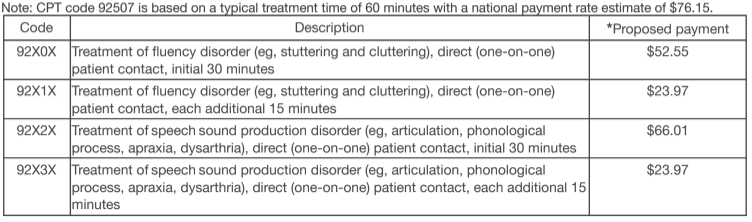
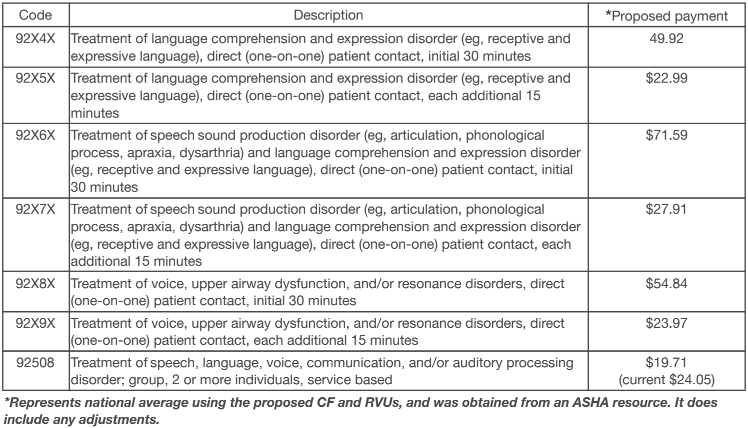
CMS accepts the new SLP treatment codes replacing 92507 and proposes the RUC-recommended work Relative Value Units (RVUs), including a decrease in 92508, which remains a service-based code and maintains the same CPT descriptor. They are also proposing the RUC-recommended direct PE inputs for all the codes in the family without refinement. The professional liability expense RVU for each code is 0.01. Additionally, they propose to designate these codes as always therapy services and apply the multiple procedure payment reduction (MPPR) to the initial 30 minutes codes. The 15-minute add-on codes would not be subject to MPPR.
Pediatric specification CMS proposes to create a new service-based HCPCS code in response to concerns raised that the new CPT codes do not accurately capture the time and intensity of work with pediatrics. Therefore, CMS proposes the following: GSLPP (Treatment of speech, language, voice, communication, and/or auditory processing disorder; individual; for the pediatric population up to age 21) With the proposed conversion factor and RVUs for CY27, the payment amount would be $66.34. GSLPP is proposed as an always therapy service, subject to the MPPR, and a work time of 60 minutes personally performed by the billing practitioner. It is also proposed to be added to the List of Medicare Telehealth Services.
Physical Therapy (PT) is commonly seen as a solution that most patients require after serious injury occurs. However, here at Powerback Rehab, we know firsthand that the use of PT goes well beyond the scope of simple injury recovery.


 Blog
Blog